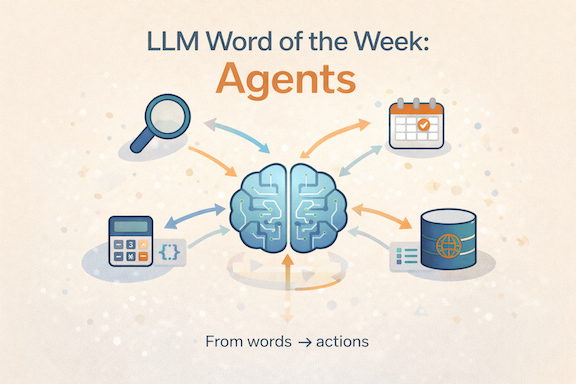
LLM Word of the Week: Agents
Agents are a type of AI system that can take actions on your behalf — not just answer questions.
While most interactions with LLMs are like asking a really smart assistant to talk, agents actually do things: they plan, make decisions, execute tools, and adapt based on results.
You could think of them as “AI workers” rather than just language responders.
What an agent does (TL;DR)
A traditional LLM-based chat answers your prompt by generating text.
An agent accepts your goal and then takes steps autonomously to achieve it, using multiple tools and sub-steps.
For example:
- You ask: “Book me a flight to Seattle next Tuesday under $350.”
- A plain LLM can draft text that looks like an answer.
- An agent can actually:
- Search flight APIs
- Compare prices
- Evaluate constraints (dates / budget)
- Present the best option
All without you breaking it into micro-prompts.
Agents combine planning, tool use, environment interaction, and iterative reasoning.
Why agents are different from basic prompts
Most LLMs do:
Input → Response
Agents do:
Goal → Plan → Actions → Observation → Next Action → Repeat → Final Result
This loop allows agents to behave more like software systems and less like static autocomplete engines.
A simple analogy
Think of a standard LLM like a skilled chef who answers:
“How do I bake a pie?”
An agent is the chef who actually bakes it:
- Checks the pantry
- Preheats the oven
- Adjusts timing based on results
- Serves the finished dish
Both understand language — only one executes.
Core components of an agent
Most agents are built from a few key parts:
- Planner – breaks a goal into steps
- Executor – performs actions using tools (APIs, search, code, databases)
- Feedback loop – evaluates results and decides next steps
- State / memory – tracks progress across actions
Together, these enable autonomy and adaptability.
Why agents matter now
Agents represent a shift in how AI is used:
- They orchestrate actions across systems, not just text.
- They reduce the need for step-by-step human prompting.
- They enable workflows like scheduling, research, debugging, and automation.
In short: agents move AI from conversation to coordination.
Key risks and considerations
Agents introduce new challenges:
- Safety – actions can have real-world consequences
- Correctness – misunderstood goals can lead to errors
- Oversight – guardrails and human review remain critical
Well-designed agents treat LLM outputs as plans, not unquestioned commands.
Final thought
If traditional LLMs are conversational partners,
agents are collaborative workers.
They don’t just respond to prompts —
they pursue goals.
And that distinction is shaping the next phase of AI systems.