LLM Word of the Week: MCP / WebMCP 🔌🌐
If prompts are what you ask, context is what the model can actually see.
That’s where MCP (Model Context Protocol) comes in.
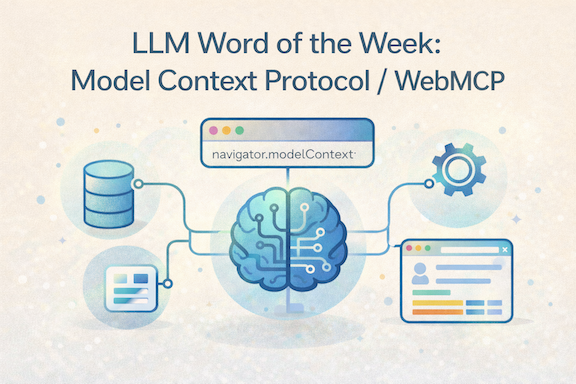
MCP is a standard way for tools, data sources, and environments to expose context to an LLM—not as raw prompts, but as structured, permissioned capabilities.
Think less “paste everything into the prompt”
and more “connect the model to the right systems.”
MCP (Model Context Protocol)
At a high level, MCP defines:
- How tools describe themselves
- What data they expose
- How an LLM can safely request and use that data
Instead of brittle prompt hacks, MCP enables:
- Discoverable tools
- Typed inputs/outputs
- Clear boundaries between model and system
The model doesn’t guess what it can do.
It’s told—explicitly.
WebMCP
WebMCP extends this idea to the web.
It allows websites and services to:
- Declare what actions are allowed
- Define what data is readable or writable
- Control how LLMs interact with them
Less scraping.
Less hallucinated APIs.
More contract-driven interaction.
Why This Matters
MCP shifts LLMs from:
“Smart text generators”
to:
“Reliable system participants”
This unlocks:
- Safer agentic workflows
- More trustworthy tool usage
- Clearer debugging when things go wrong
- Better separation of model logic vs system logic
For engineers, it’s the difference between:
- Prompt spaghetti 🍝
- And real interfaces
Mental Model
LLMs don’t become powerful by knowing more words.
They become powerful by being connected—correctly.
LLM Word of the Week is a weekly series breaking down one concept that quietly shapes how modern AI systems actually work.